Gutter Guard Cleaning: What Still Builds Up on Top
Guards keep the big debris out. Fine material, pollen and shingle grit still collect, and it collects on the guard itself.
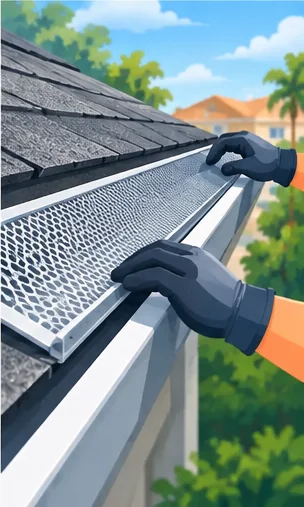
Why guarded gutters still overflow
A guard works like a lid. Leaves ride across it and drop off, but oak catkins are thin and fibrous and can lie flat on mesh, where they dry into a felt-like skin. Tree pollen in Central Florida is among the heaviest spring allergen loads, and the extension service advises a dust mask when raking leaves (UF/IFAS). That same fine material can sit on top of a guard and in its openings.
When the surface seals, rain skips past the guard and over the edge. The gutter underneath may be perfectly clear while the roofline looks as if it has no gutter at all.
What the work involves
We usually brush or blow the surface clear first. If the guard type allows it, sections are lifted out so the trough and outlet underneath can be checked for the fine silt that gets through. Some systems clip in and come up easily; others are fastened down, and those can take more time and carry more risk of bending.
It helps to tell us what kind of guard you have, because the approach differs for screen, mesh and solid-cover designs. If you do not know, a photo of the roofline helps.
How often to look
Guarded systems are often cleaned less often than open ones, but the calendar still applies. Spring catkins and pollen are the obvious trigger, and after a major storm, fallen twigs and fine debris can be matted on top. A quick look from the ground after a downpour tells you plenty: if water streams over the guard's edge rather than draining through it, the surface needs attention.
For an open question about your own system, request a quote and mention the guards. We confirm on the call what is feasible on your particular product.
See what the clog is costing your roofline
Overflowing gutters rarely fix themselves. Request a free quote and we will call to confirm the details.